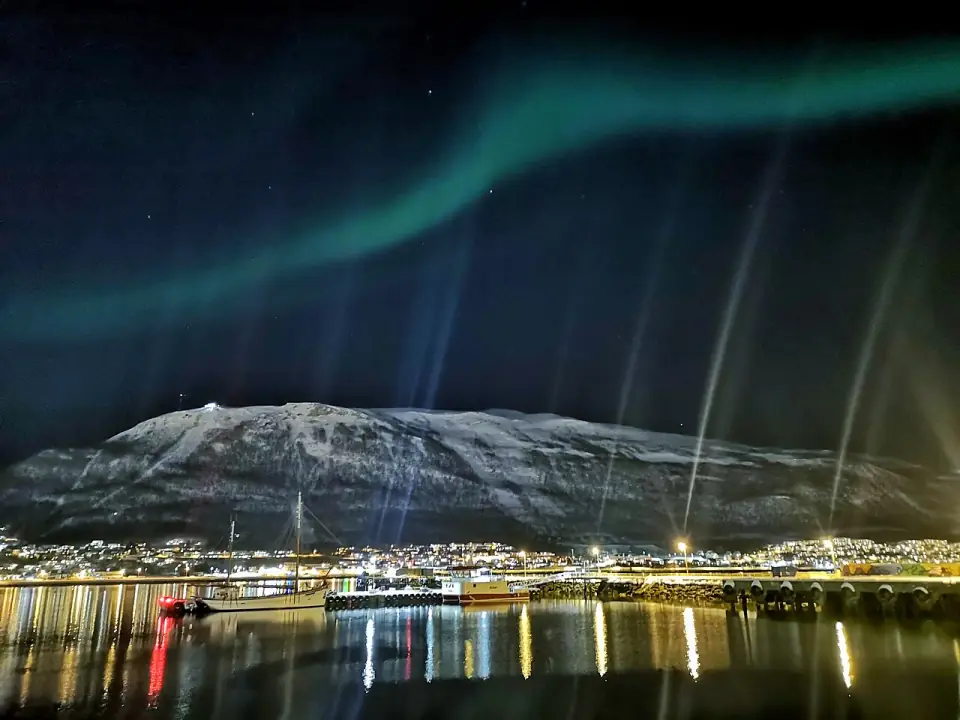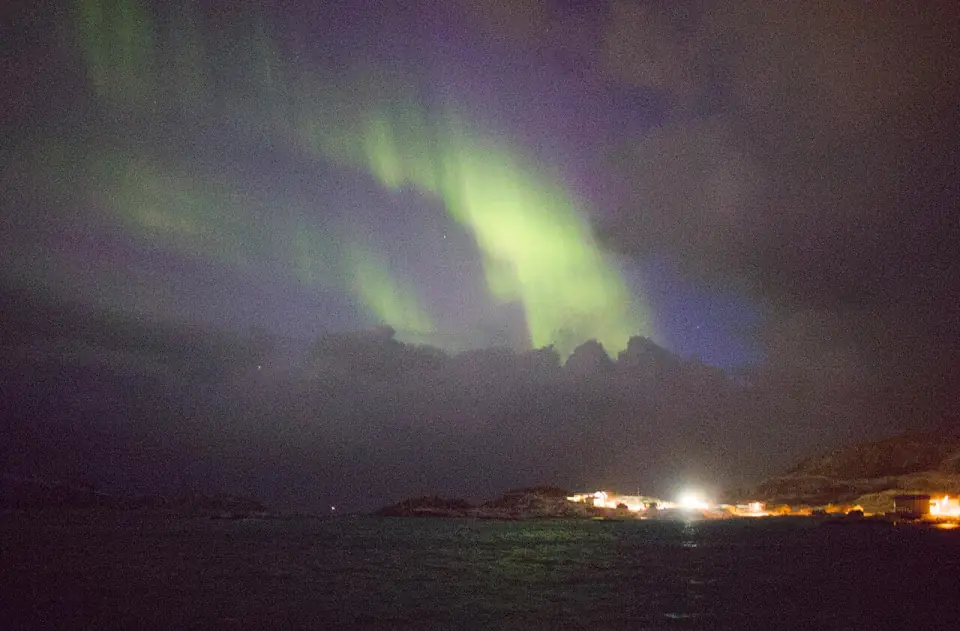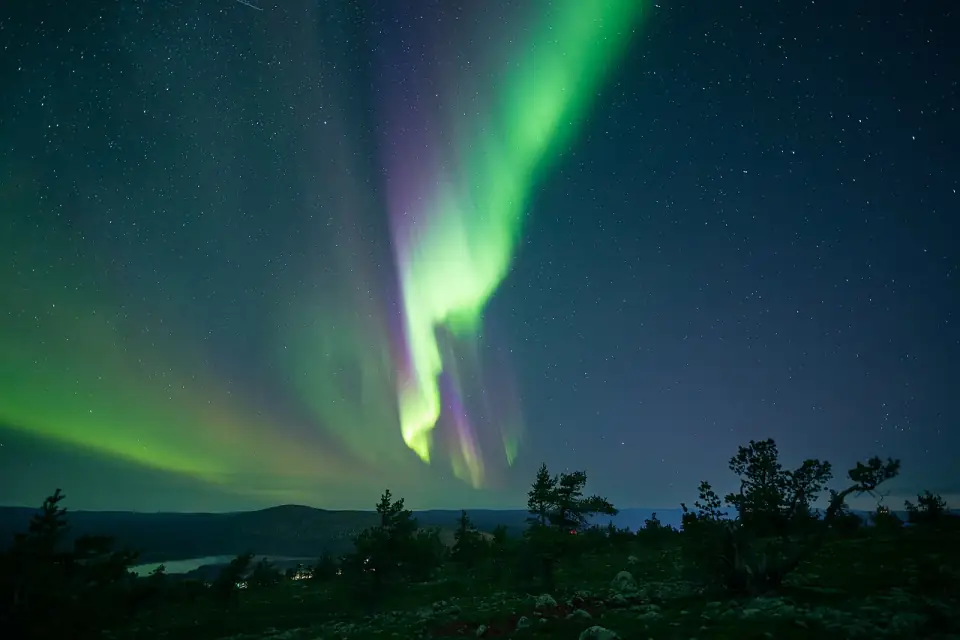
We live in Tromsø. In winter the same question comes up almost every evening, from visitors and from people who have lived here all their lives: should I go out tonight, and if so, where and when?
Aurora Atlas is our answer to that question. It started as a small app for one city. This is the story of how it grew.
We had the idea in early March this year. Since then we have been building step by step, with one goal in mind: to make the best northern lights app out there.
Why Tromsø first
Tromsø sits under the auroral oval. On the scale scientists use, its magnetic latitude is about 67°, which means that even on quiet nights the aurora is often overhead. That makes the hard part of an aurora forecast here not "will there be aurora?" but "will I be able to see it?": clouds, darkness, the moon, and which of the fjords and valleys around town has a clear sky.
That is a local problem, and we wanted to solve it properly for one place first. Starting local let us test the concept, and our aurora forecast engine, against real nights in a place we know well, before saying anything about the rest of the world.
The first version
The first commit is dated 5 March 2026: "initial Tromsø northern lights MVP". A backend and a web preview followed the next day. Within the first week the app had a daytime warning (it is surprisingly easy to show a "go now" when the sun is up), a score for tomorrow and a three-day outlook.
Then came a long stretch of work before anything reached a store. In July the spot list was rebuilt and checked against Tromsø kommune's own data, the app got five languages (English, German, French, Spanish and Chinese), and the backend got tests and the ability to survive restarts. On 18 September 2026 the app went live on the App Store as Aurora Tromsø Northern Lights.
Updates followed quickly. Version 1.2.0 at the end of September added an Aurora tab, sky camera stills and road information. Version 1.2.1 made the onboarding personal: are you visiting, planning a trip, or do you live here, and how far will you drive? Version 1.2.2, released on 15 October, brought the spot list to 41.
What people asked for
What people wanted was an app that helps them make a decision. The forecast on its own is hard to read, and it is spread across different sources: a cloud map in one app, the Kp index on one website, the solar wind on another, and the moon and darkness somewhere else. Putting it all together into "go or not, where and when" is exactly what most people do not want to do on a cold evening.
The feedback on the Tromsø app was really good. And one question kept coming back: why is it only available in Tromsø? People were travelling on to Lofoten, to Abisko, to Lapland and to Iceland, and wanted the same answer there.
What was hard
Clouds
Tromsø is on the coast, and the coast is often cloudy in winter. A single "80 % cloud" number tells you very little: it can be a thin veil you can see the aurora through, or a lid of low cloud. What matters is the hour, the height of the cloud, and the place. Driving 40 minutes inland can change the night completely. The app therefore scores every spot from its own hourly forecast from MET Norway, with low, middle and high cloud counted separately, and the score multiplies clear sky by aurora activity, so a gap in the cloud only counts when there is something to see through it.
Darkness
It sounds trivial until you get it wrong. One of the first scoring fixes, in July, was "darkness-aware scoring and an honest polar-day state": the app should not recommend a window when the sun has not set, and in May and June it should say plainly that there is no aurora season. In September we fixed it again so that the best window can never start in daylight, and the "Go now" button only appears when the window is near.
The spots
A viewing spot is only useful if it is real: a place you can park, with a view north and without streetlights in your eyes. In August we found nine spots whose coordinates were in the water or off target, and corrected them. In October four spots got a worse light-pollution rating after we compared them with satellite measurements of night-time light. The hand-assigned values had been too kind.
The score
The score has been rebuilt more than once, and the scoring model is documented constant by constant. The most instructive moment came in October. On a quiet night, with the Kp index at 0.7 and a mostly clear sky, the app said 75 out of 100. That reads as "go", and on such a night there is often little to see. The cause was the formula: clear sky alone could carry the score. Now the score is clear sky times aurora activity, and the activity for the next few hours comes from what NOAA's OVATION model measures right now, not only from the three-hour Kp forecast. The same night now scores 48.
The idea: one engine, many places
Eleven days after the App Store launch, on 29 September, we started a new codebase. In July the plan had been to stay with Tromsø only for the whole season. The questions from users changed that: if people were asking for the app everywhere they travelled to see the northern lights, we wanted to build it properly for those places too.
The idea is simple to say. Everything that is physics or weather works for any place on Earth: magnetic latitude, darkness, the moon, layered clouds, the score and the best window. That became the Aurora Engine. Everything that is local knowledge, the named spots, parking and bus notes, webcams and tips, lives in a region pack. Tromsø is the first region pack. Its output is pinned by tests, so building the rest of the world cannot quietly change the Tromsø scores.
An important detail is magnetic latitude. The aurora follows the Earth's magnetic field, not the map, so Iceland sits closer to the oval than its geographic latitude suggests, and a "Kp 3" means something different in Iceland than in southern Finland. The engine uses the AACGM-v2 magnetic coordinate system for every place, and works anywhere, not only inside a region pack.
How the current version handles data
The 1.x versions offered optional, consent-based analytics. The current Aurora Atlas version does not include analytics or advertising software, and the analytics data collected by 1.x is deleted when version 2.0 is released. Location is optional and is used on your phone for destination selection and drive estimates. The server receives requests for public forecasts by destination and does not log IP addresses. The privacy policy describes the current version and the differences from 1.x.
If future features handle information differently, that will be explained in the app and reflected in the privacy policy when those features are introduced.
What Aurora Atlas adds
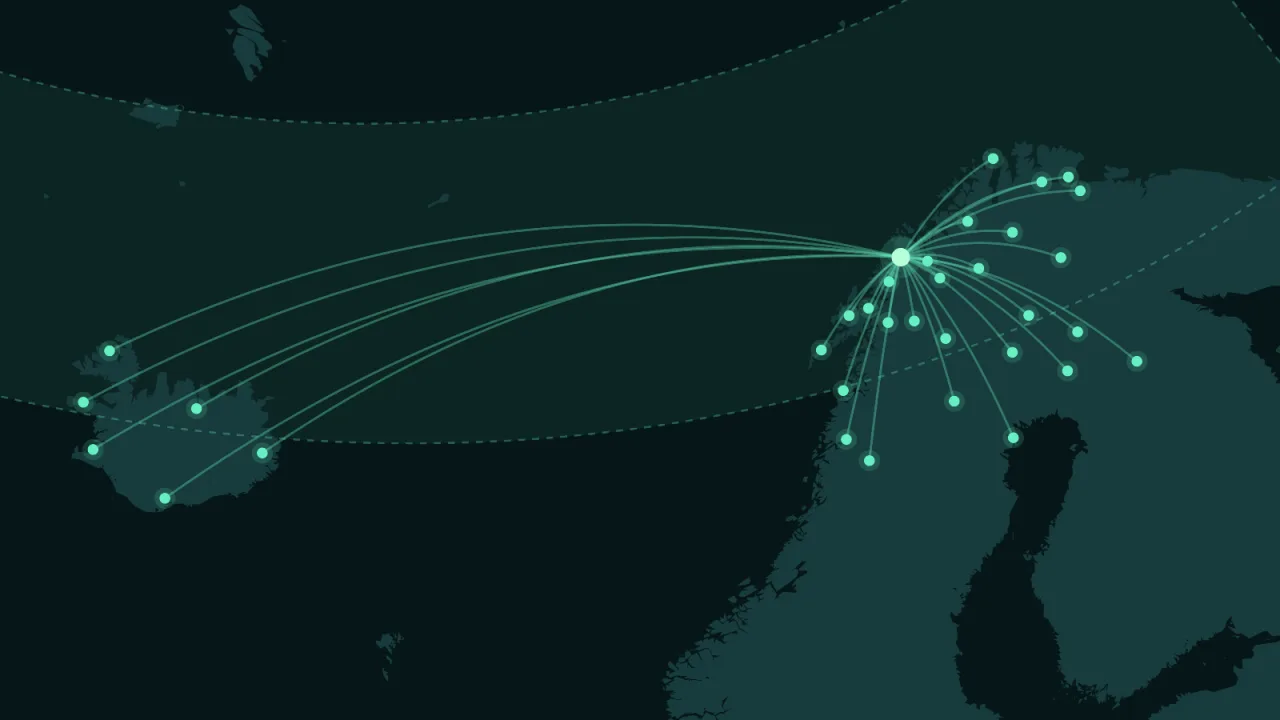
Aurora Atlas is the same app, version 2.0 of Aurora Tromsø, now covering 35 aurora destinations across Norway, Svalbard, Sweden, Finland and Iceland, with a basic forecast for any other place you pick. If you already have the app, your settings carry over.
- 41 spots around Tromsø, with drive times, bus and parking notes.
- Hand-picked spots at other destinations, such as Lofoten, Senja, Abisko, Finnish Lapland, Svalbard and Iceland.
- Your base and your range: pick where you are staying and how far you will drive, and the app ranks the spots within reach.
- Trip Mode: enter your dates and see each night's darkness, moon and typical sky.
- A map with the aurora oval drawn over it, and sky and road cameras where they exist.
- A written analysis on request, written from public forecast data, never from anything about you.
- Eight languages: English, Norwegian, Swedish, Finnish, German, French, Spanish and Simplified Chinese.
More destinations are on the way, one by one.
What's next
Aurora alerts are designed but not shipped. The design keeps your exact location on your phone and subscribes only to a coarse area, and the app will ask first and the privacy policy will change first. The forecast is archived every three hours so the score can be checked against real nights over the coming season.
If you have a night that the app got wrong, we want to hear about it: hello@auroraatlas.app.
Aurora Atlas is free on the App Store.