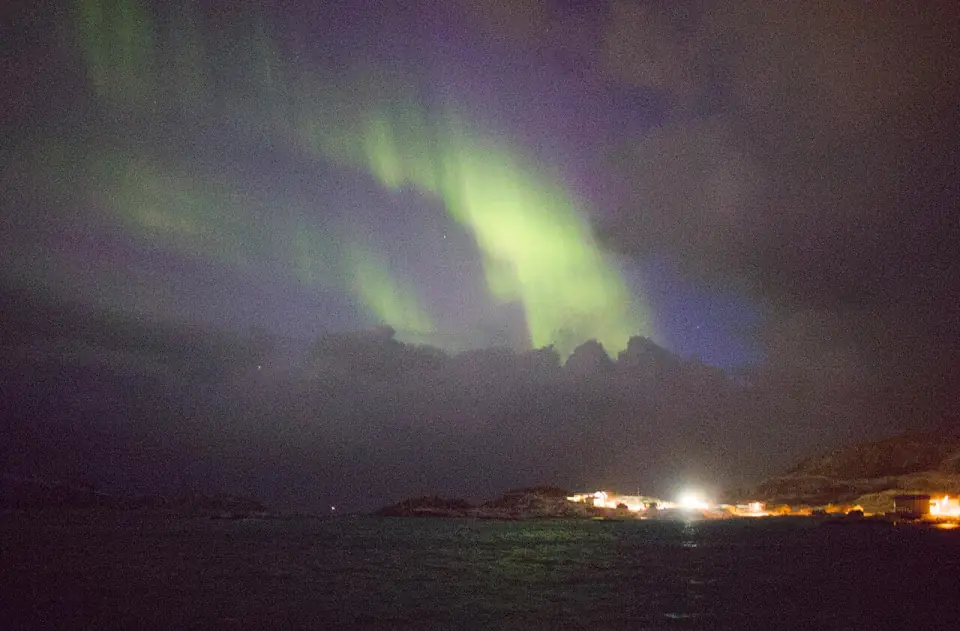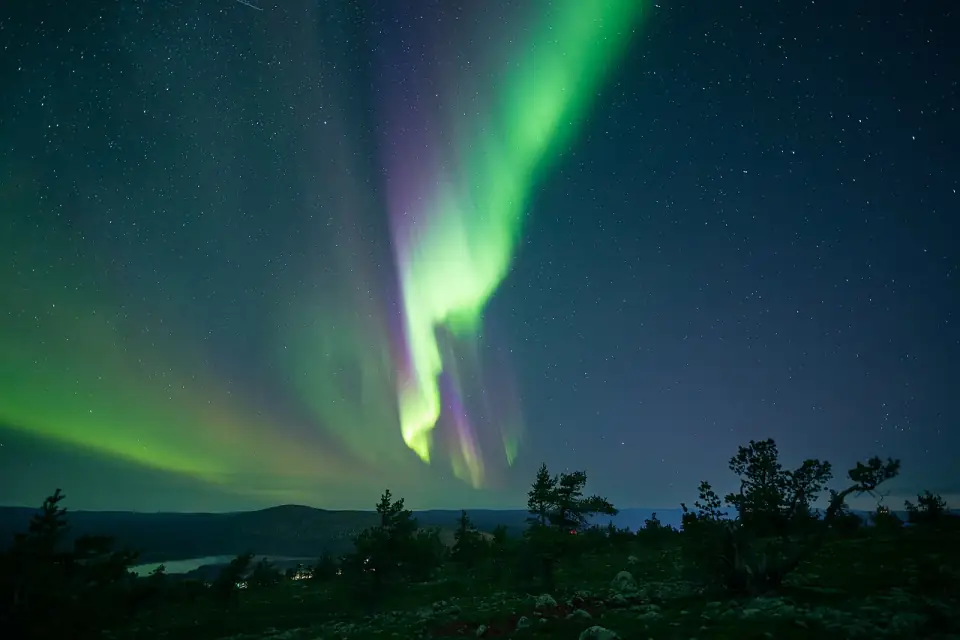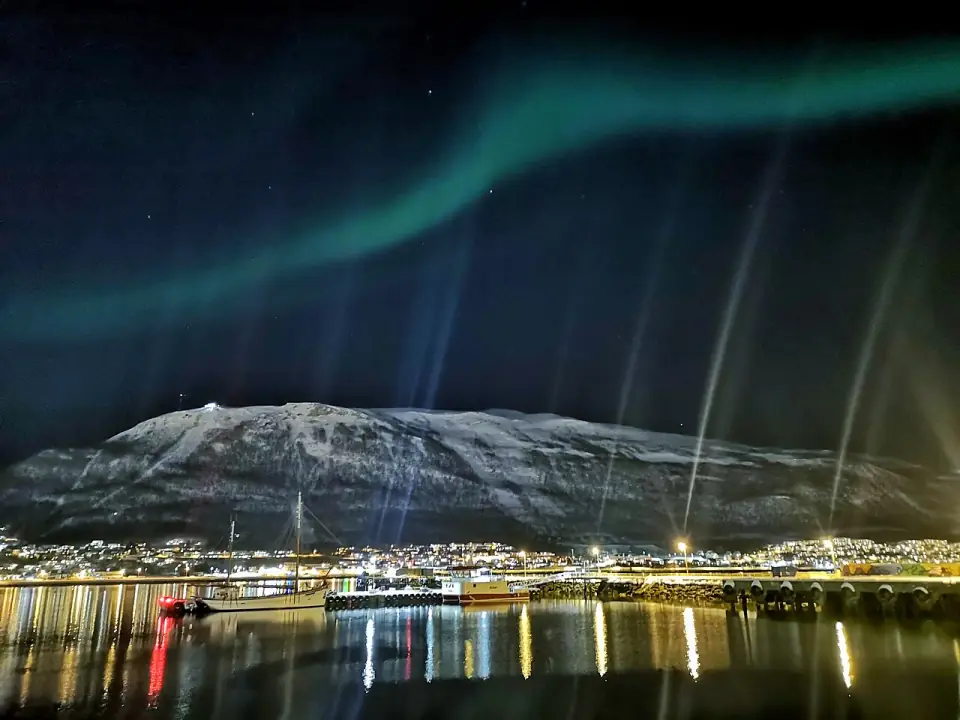
Tromsø lies under the auroral oval, so the aurora is overhead here on many nights. The question is rarely "is there aurora?" and almost always "can I see it?". That depends on four things: the season, the hour, the moon and the weather. Here is how each one works in Tromsø.
The season: late August to early April
Visit Tromsø gives the northern lights season as late August to early April. The limit is darkness, not the aurora: in summer the sun hardly sets, and the aurora is invisible in a bright sky.
How much real darkness you get changes a lot through the season. Counting the hours with the sun more than 11° below the horizon in Tromsø (the threshold Aurora Atlas uses for "fully dark"):
- Late August: the first short dark spell around midnight.
- Around the September equinox: about 7 hours.
- Mid-October: about 11 hours.
- Mid-November: about 14 hours.
- Midwinter (late December): about 17 hours.
- Around the March equinox: about 8 hours.
- Mid-April: the last nights with any full darkness.
Polar night is not "all night aurora"
In the 2026–27 season the sun stays below the horizon in Tromsø from 28 November to 14 January, according to MET Norway's sunrise calculations for the city centre (it peeks up for about 20 minutes on 27 November and returns on 15 January). That is the polar night, the mørketid; behind the mountains around town you will not see the sun for a while longer. It gives the longest dark hours of the year, and aurora can appear in the afternoon. But the middle of the day still has a blue twilight, and December is on average the cloudiest month of the season (see below). It is a beautiful time to visit, not a guaranteed one.
The equinox effect
NOAA's Space Weather Prediction Center lists the weeks around the spring and autumn equinoxes as the best seasons for aurora watching, because geomagnetic activity tends to be higher then. It is a statistical effect: it raises the odds over a week, not on a particular night.
What the season does not change much is the cloud. NASA's satellite cloud record (CERES, 2001–2025, via NASA POWER) gives Tromsø an average cloud amount of about 82 % in September and October, 84 % in November, 85 % in December, 83 % in January and 85 % in March. Every month of the aurora season is cloudy on average, and the differences between months are small. So the season mostly decides how many dark hours you get and how active the sky tends to be; whether your night is clear is decided night by night, and that is what a forecast is for.
If you can choose: late September to October, or March, puts you near the equinox with plenty of dark hours. If you want the polar-night atmosphere, go in December or January. Either way, plan several nights, so that one clear night is likely.
The hours of the night
NOAA's guidance is that the best aurora is usually within an hour or two of midnight, roughly 22:00 to 02:00 local time. On active nights it can start much earlier, soon after dark, and in Tromsø in October that can be well before 20:00.
Practical advice:
- Be ready from dark. Do not plan to go out at midnight and stay in until then.
- Give it time. The aurora comes and goes. A quiet sky at 21:00 can be filled at 22:30.
- Watch the window, not the clock. Aurora Atlas gives each spot a best three-hour window from the hourly forecast, so you can see whether the sky is clearest early or late.
The moon
A bright moon does not change the aurora, but it makes it look fainter. SWPC says the full moon diminishes the apparent brightness. In practice:
- On a strong night, the moon hardly matters, and a moonlit landscape can make for better photos.
- On a quiet night, a high full moon can hide a faint glow that you would otherwise see.
A moon below the horizon does not matter at all, even if it is full. Aurora Atlas takes the moon's phase and height into account for every hour, and the effect fades out on strong nights.
The weather: coast versus inland
Tromsø is on the coast, and in winter the coast is often cloudy. This is the single most important thing to understand about aurora hunting here: clouds decide more nights than the aurora does.
The good news is that the weather around Tromsø is very local, and the cloud on a given night can differ a lot between the coast and the valleys inland. On average the difference is modest: in the same NASA satellite record, the area inland towards Skibotn and the Finnish border has about 4–5 percentage points less cloud than Tromsø in November to January (roughly 78–81 % against 83–85 %; the record is coarse, about 100 km per grid cell). On a single night it can be the difference between overcast and clear, in either direction: sometimes the inland valleys are open, sometimes the outer coast to the west is. Local guides drive for this reason, sometimes all the way into Finland.
What to do:
- Look at the hourly cloud forecast for each spot, not one number for "Tromsø". Clouds move, and a gap of two hours is enough.
- Be willing to drive. Thirty to ninety minutes can change the night.
- Check the forecast again before you leave. MET Norway updates its forecasts many times a day.
How to choose a spot
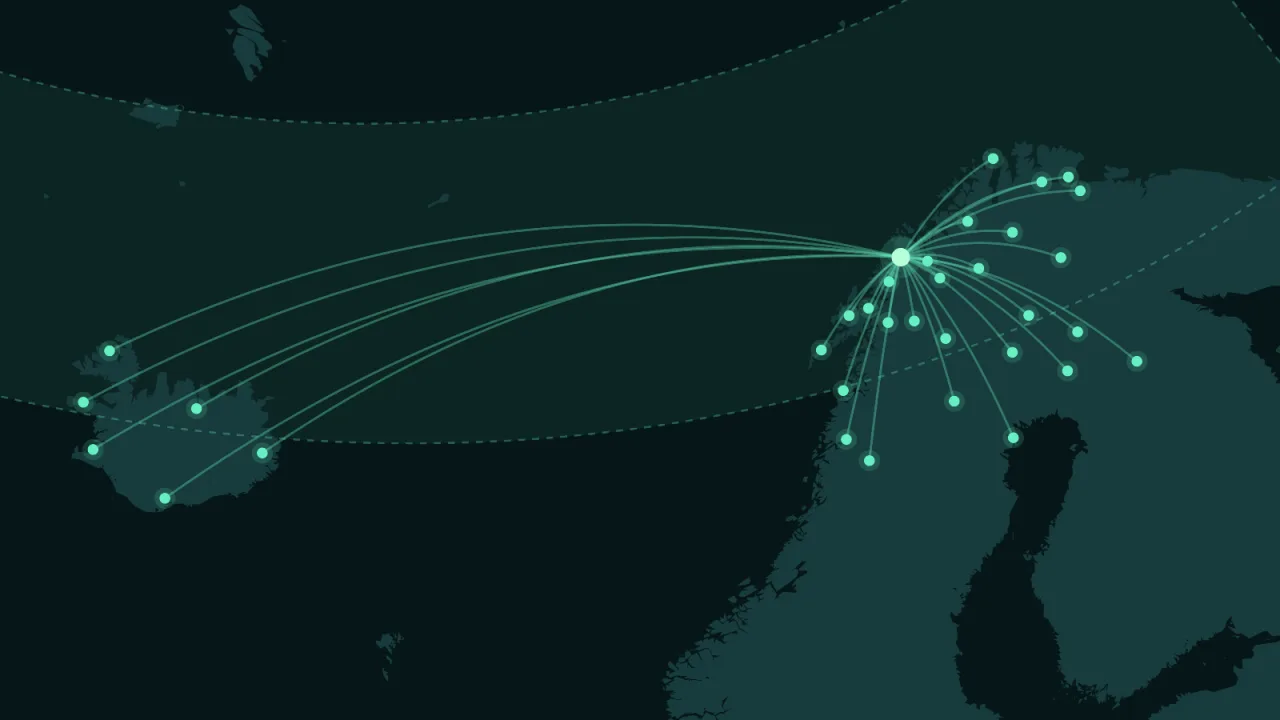
A good aurora spot has three things: a view to the north (the aurora is often towards the north from Tromsø, though it can fill the whole sky), dark surroundings, and somewhere safe to park. A few examples from the 41 spots in Aurora Atlas:
- In town: Telegrafbukta, on the southern tip of Tromsøya, is easy to reach by bus and on foot. It is not truly dark, but on a strong night it is enough. Prestvannet, the lake in the middle of the island, shows the limit: streetlights nearby keep the sky bright.
- Kvaløya, 20–45 minutes: Ersfjordbotn is the classic fjord spot, with mountains and reflections, and has a bus stop. Kattfjordeidet and Grøtfjord are darker, with open views north.
- The outer coast: Sommarøy, about an hour away, has very dark skies and a horizon over the sea.
- Inland, when the coast is cloudy: Skibotn and Signaldalen are 90–100 km away in drier inland valleys. Kilpisjärvi in Finland, about 160 km away, is the long-drive option.
The full list is on the Tromsø page, with drive times and notes on parking and buses.
Staying safe in the Arctic winter
Dress for standing still in the cold, not for walking: layers, a warm hat, mittens and insulated boots. Never stop on the road or in a bend to look at the sky; use proper parking. Check road conditions with the Norwegian Public Roads Administration before you drive, as mountain roads can close in bad weather. Do not walk out on frozen lakes or fjord ice, and tell someone where you are going.
In short
- Season: late August to early April. September–October and March balance darkness, activity and clearer skies.
- Time: from dark until after midnight, with the best odds around 22:00–02:00.
- Moon: matters on quiet nights, hardly on strong ones.
- Weather: decides most nights. Look at hourly clouds per spot and be ready to drive.
- Spot: north-facing, dark, with safe parking.
Sources
- Visit Tromsø: Winter in Tromsø
- NOAA SWPC: Tips on viewing the aurora
- NOAA SWPC: Aurora
- NASA POWER: climatology API, cloud amount (CERES SYN1deg, 2001–2025)
- MET Norway: Sunrise API (sun times for Tromsø)
- MET Norway: Locationforecast data model
- Yr (MET Norway and NRK): weather forecasts
- Statens vegvesen: Traffic information
- Tromsø Geophysical Observatory, UiT
Aurora Atlas scores all 41 Tromsø spots for tonight, hour by hour. It is free on the App Store.